Establishing a Legal Framework for Sustainable Peace
Our duty for peace
It is everyone's duty to reduce the existing causes of conflict and pursue harmonious coexistence.
Why we need law for peace
After two devastating world wars, the United Nations was founded for the purpose of preventing war and maintaining international peace and security. Since then, many international instruments have been developed to ensure peace, and the global community recognized the need not only to prevent and prohibit armed conflict and violence but also to cooperate with each other.
Still today, many factors such as interfaith conflict, ethnic hatred, and cultural prejudice are threatening peace. The international community should work towards a comprehensive legal solution that can secure peace and protect the daily lives of all citizens regardless of their nationality, ethnicity, or religion.
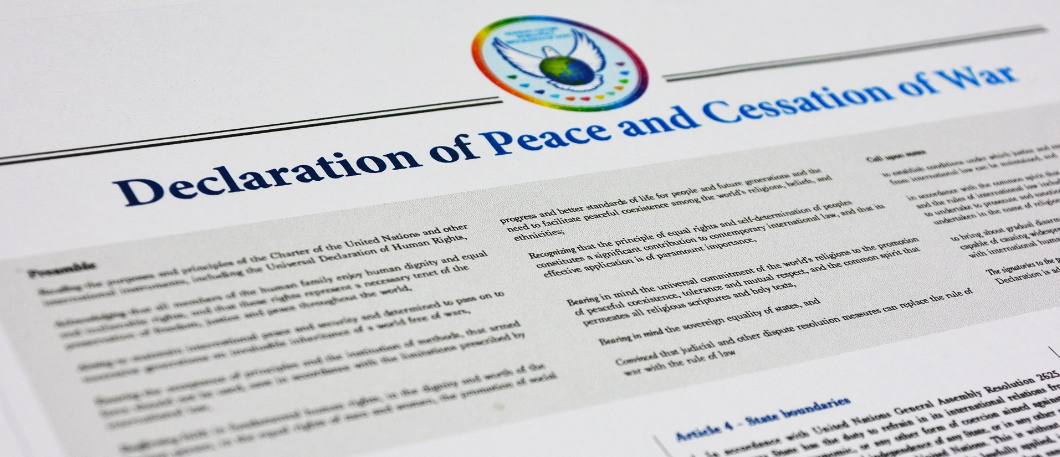
By preparing a legal instrument that can ensure and maintain peace at the national and international levels, we can turn our world into a peaceful place. HWPL is engaged in peace activities centered on the Declaration of Peace and Cessation of War (DPCW) with the aim of establishing a legal framework for sustainable peace.
What is the DPCW?
On 14 March 2016, HWPL proclaimed the Declaration of Peace and Cessation of War (DPCW), which was drafted with the participation of international law experts from 15 countries.
This declaration, comprised of 10 articles and 38 clauses, aims to restore the spirit that served as the basis for the establishment of the United Nations and to achieve sustainable peace by promoting the universal values of the global community. The DPCW embodies the principles and measures for preventing and resolving conflicts and sustaining a peaceful global society.
Three Important Values of the DPCW
1
Prevention of Conflict
Articles 1-5
Call upon States to cooperate towards gradual disarmament, repurpose weapons manufacturing facilities to serve purposes that are beneficial to humanity, and develop friendly relations based on respect for the principle of equal rights and self-determination of peoples.
2
Settlement of Conflict
Articles 6-7
Reaffirm the role of international supervisory bodies in maintaining global peace and security and call for arbitration, mediation, and conciliation as means of settling disputes peacefully.
3
Maintenance of Peace
Articles 8-10
Address the principles and conduct that can maintain a peaceful global society once it is established, including freedom of religion, religious and ethnic harmony, and spreading a culture of peace.
The 10 Articles of DPCW
1Prohibition of the threat or use of force
2War potential
3Friendly relations and the prohibition of acts of aggression
4State boundaries
5Self-determination
6Dispute settlement
7Right to self-defence
8Freedom of religion
9Religion, ethnic identity and peace
10Spreading a culture of peace
Read more about the DPCW and the international support it has gathered:
HWPL's journey toward establishing a legal framework for peace has been marked by significant achievements around the world.
2022
MOU with PARLANDINO
September - Signed a Memorandum of Understanding with the Andean Parliament (PARLANDINO).
2020
Resolution in Kapalong, Philippines
January - Adopted a Resolution Supporting the DPCW in Municipality of Kapalong in the Province of Davao del Norte.
2019
Coalition of Caribbean Leaders for Peace
December - Signing of MOA with the Coalition of Caribbean Leaders for Peace (CCLP), comprised of nine former presidents and prime ministers of seven Caribbean countries. September - Adopted a Resolution Supporting the DPCW in Cotabato City, Philippines.
2018
Global Partnerships & UN Conference
September - MOU with the International Centre for Black Sea-Baltic Studies and Consensus. July - MOU with the Pan-African Parliament (PAP), the legislative body of the African Union. May - Peace Conference for UN Permanent Representatives attended by representatives of 145 countries at UN Headquarters.
2017
PARLACEN Resolution
July - Adoption of a resolution in support of the DPCW by PARLACEN, a parliament of six member states including Guatemala.
2016
DPCW Proclamation & LP Program Launch
March - Proclamation of the 10 articles and 38 clauses of the DPCW. Launch of the "Legislate Peace" (LP) program to advocate the DPCW along with youth and women.
2015
HWPL International Law Peace Committee
September - Inauguration of the HWPL International Law Peace Committee, comprised of 21 international law experts from 17 countries.
2014
Agreement for International Law on Peace
September - Signing of the Agreement to Propose the Enactment of International Law for the Cessation of Wars and World Peace by 29 national leaders including incumbent and former heads of state.
Main Initiatives
HWPL works to build support for the DPCW from governments, international organizations, civil society, and educational institutions worldwide.
1
Support from Governments
Five countries – Seychelles, Eswatini, Comoros, Antigua and Barbuda, and Saint Vincent – have expressed their support for the DPCW at the national level. High-ranking leaders of eight Pacific Island countries announced a follow-up agreement, and the National Assembly of Ecuador prepared a letter supporting the DPCW.
2
Support from IGOs and Former Heads of State
Former Prime Minister Said Musa of Belize formed the Coalition of Caribbean Leaders for Peace (CCLP), a group of former presidents and prime ministers of the Caribbean Community member states, to support the adoption of the DPCW at the international level.
HWPL signed a memorandum of understanding with the Pan-African Parliament (PAP), the legislative body of the African Union, to cooperate on peace work.
The International Centre for Black Sea-Baltic Studies and Consensus, whose members are former heads of Eastern European states, signed the Goseong Agreement to work together for the implementation of the DPCW.
The Central American Parliament (PARLACEN) passed a resolution in support of the DPCW, and former and current national leaders of Pacific Islands countries signed the HWPL – Pacific Islands Comprehensive Agreement on Advocacy for the DPCW.
3
Support from Civil Society
Since 2016, the "Legislate Peace" (LP) program has collected signatures supporting the DPCW from about 730,000 citizens around the world.
Moreover, 176 high-ranking leaders such as former and current heads of state, chief justices, and speakers of parliaments have signed their support for the DPCW.
Even before the DPCW was proclaimed, its principles were already being practiced in Mindanao, Philippines. The region is on the path to peace after ending the military collision between the Philippine government and Moro groups, which lasted over 40 years and resulted in more than 120,000 casualties.
Seeing how peace was being created in Mindanao according to the Declaration of World Peace, the foundation document of the DPCW, HWPL became certain that a law for peace can transform conflict into peace.
Since the DPCW was proclaimed, Mindanao has taken the lead in implementing the DPCW in practice. Mindanao's governor and a religious leader achieved interethnic and interfaith reconciliation (Article 5 and 9 of the DPCW), civil society is involved in the LP program, and the Ministry of Education is introducing peace education to the region (Article 10 of the DPCW).
5
DPCW Curriculum
On 14 March of every year since 2015, the HWPL International Law Peace Committee meetings have been held, where international law experts discussed ways to achieve the adoption of the DPCW at the international level and contribute to the realization of peace.
In order to provide students of law with quality education on the values of human rights and peace in the DPCW, a curriculum was completed in 2020. Currently, education is being offered in India and Bangladesh, and discussions are underway to introduce the DPCW Curriculum to more countries.